Sunday, August 16, 2015

Book Review: 'The Sound of Things Falling' by Juan Gabriel Vásquez

’Sometimes I think,’ he told me the only time we talked somewhat seriously, ‘I’ve never looked anyone in the eye.’
And the man speaking here, Ricardo Laverde, never looks you, the reader, in the eye either. Even at the end. Perhaps, even then, when you have heard the whole story, then, you realise just how much you haven’t learned about him. It’s an unmystery.

 But he is a pilot.


 This is a book translated from Spanish to English written by a man who is a translator of literature from French to Spanish. And ‘translation’ could certainly be considered an identifiable theme here. Not just from a language to a language, but any kind of translation of experience in the form of language into a story.
’He must’ve done something.’
But what did he do? And that’s the story of the story. I enjoyed its slow unveiling through the range of different story-telling frames Vásquez plays with. And he plays with the reader like maybe only Spanish writers do. There are some turns of phrase which come off as a little naive and twee in English, but there's this very recognisable way modern Spanish reads (In English that is ... which is all I know). Marquez looms over them all, since Cervantes seems completely different. But there's always this magic-realist lilt to it, and the way repetition is used like it's verse.
’No, wait,’ I tried to say, but it was too late, she’d got rid of the phone and left me in Aura’s hands, my voice in Aura’s hands, and my nostalgia hanging in the warm air: the nostalgia for things that weren’t yet lost.
People reading the blurb of my edition might be disappointed in the story; the ’literary-noir’ call is a bit off: more literary than noir. But that’s not Vásquez’s fault. The action is chiefly internal, but it certainly kept me ‘at it’. Sometimes there is a sense of disappointment ... but Vásquez manages to maintain this interesting sense of background foreboding and oppressive weight, the reading equivalent of living in Colombia during the Escobar years, an era that looms over the story as a whole, and, an entire generation of Colombians: our protagonist, Antonio Yammara, among them. And this kind of disappointment and exhaustion seems to be an important sense to develop. There is a generational shared experience through Escobar and his ‘stories’ (which were once all-to-visceral in nature, of course) and, especially, his place of residence.

 
And sometimes she asked him, ‘Do you like planes?’
Flying is an important trope in the book, as a means of legend-building, bravado, escape, living, dying and trafficking. Certainly, as an essentially destructive means of connection to the gringos it becomes self-evident. It allows one to reach out to the other, and the other to reach back: the big planes coming in, the little planes returning...
’And you, Señorita Fritts, do you know when you are going to die? I can tell you?’
And we do, of course. Death in the story is always invested with heavy dramatic irony. We know where these people are headed. We get to hear the black box recording first, then we work backwards. And that’s where the moral ground gets murky, in the sense of agency and outcome, and the smaller people caught up in larger things for a range of different reasons. Vásquez handles these things with great style and a languid sense of character ... if, at times, a little unsubtly. His impressions of his homeland and home-city are fascinating literary travelogues easily worth the price of the fare alone...
Then I realised no one wants to hear heroic stories, but everyone likes to be told about someone else’s misery.

Thursday, August 6, 2015

Book Review: 'Stoner' by John Williams

When it comes to titles of books that have not aged well, this one has to be up there with Nietzsche’s 'The Gay Science'. When it was suggested to me by a goodreads friend, I thought that he must’ve found out about my thing for ‘The Big Lebowski’...

But it turns out to be the surname of the protagonist, one William Stoner, who shares attributes with the author of the book, John Williams, e.g. insofar as being a long-term academic in an American Department of English ... so much so that there is a much more strident than normal warning-cum-dedication from the author to his former colleagues at the University of Missouri to the tune of ‘this is fictional, and I’m not taking the piss out of any of you...’ It is a book that is easy to read and strangely affecting. I cried at the end. But what these tears were for is hard to say. And I find myself thinking about Stoner at odd times of the day. Was it because of people I have known? My own (albeit even less grand) experience as a doctoral student in what passes for an English department at the turn of the millennium in Australia? Just the purity of the prose and its vision? Maybe all these things and more. It’s certainly a kind of porn-for-literati what Williams throws on the page: literature about loving literature and cherishing it and valuing it, and its learning.
The love of literature, of language, of the mystery of the mind and heart showing themselves in the minute, strange and unexpected combinations of letters and words, in the blackest and coldest print—the love which he had hidden as if it was illicit and dangerous, he began to display, tentatively at first, and then boldly, and then proudly.
And, in the end, the book is about Meaning ... which is kind of weak to say, since I suppose everything is, in the end, but it’s appropriate, since it touches on the idea of Meaning-making. Two world wars go on in the background of Stoner’s life, and much Meaning was being made there, but Williams explores the extraordinary in the ordinary, and even a kind of ordinary that is often decked in failure and disappointment.
...in the long run, all things, even the learning that let him know this, were futile and empty, and at last diminished into a nothingness that did not alter.
In the shorter term, there was recourse to learning, and there was literature for that, something that:
...changed the world which was its subject, and changed it because of its dependence on it.
There’s no classic victory for Stoner, not in career, marriage, love, family ... nothing. His efforts were futile. The results, empty. And he diminishes into nothingness. The end.


But, of course, the book is also curiously uplifting, in just the right sort of ordinary ways. There is a presence in being a presence, and there is the joy of being alive, knowing you are alive, proclaiming it through all the different ways you are capable—through lust, through learning—that you: are.
He was himself, and he knew what he had been.
The intensity of his practical involvement with language and learning, his passion and spirit for it, and then the tension of trying to communicate this to others, through words—‘...knowing something through words that could not be put in words...’—is foremost throughout his life, and the agony of coming to terms with our imperfect faculties to do this. His inadequacy is all of our inadequacies. I mean, just writing this simple review and trying to imbue it with what I want it to have in it is just another feeble example. All this hot and living stuff is there, right there, just as for Stoner ... but, then:
What was most alive withered in his words; and what moved him most became cold in the utterance.
Williams wrote this in the mid 60s, and his timing was probably poor. One can’t but help to consider his placement of Stoner back as a freshman in 1910 as some kind of review of the Academy he found himself in after his post WW2 undergraduate years. When Stoner is being leant on to pass a student called Walker who deserves to be failed, he digs his heels in. Departmental politics, professional threats and even the acknowledged futility of the gesture are not enough to persuade him otherwise.
”We can’t keep the Walkers out.”
He’s told. And they can’t. And they don’t.


Walker is a great talker, his rhetoric is fast and full and dripping, and he can skirt around the generalities of literature and English with slimy ease. But he knows nothing about the works themselves. He hasn’t really read anything ... except what has been written ABOUT them. Stoner is shocked that Walker had got to postgraduate level in English without any Greek or Latin or German or French. And they didn’t keep the Walkers out. My English departments are all post-Walker. And I kind of wish I could have had a shot at Stoner’s pre-Walker time. I cruised through, enjoying what I was doing, and getting great results and scholarships, but I was never really pressed. Not like Stoner and his ilk were. Chaucer and Beowulf? Not in translation? What? And how they get Stoner, with a reputation smear claiming he was opposed to Walker because of his physical disability would’ve been even worse today. It might have trended on Twitter, if no lions had been shot that week, and Huff Post could’ve done a feature on disability prejudice. And then his affair with a female student. Facebook would’ve been burning with Jezebel op-eds, and Mamamia could’ve followed on the currency-ebb with a Top Five Things we Hate about Stoner.


 Was Williams seeing this develop in the 60s, and pitching the Walker back to the 30s as the worm inside the fruit? Williams is also a beautiful stylist with a deep sensibility. He has the capacity, through Stoner, to bring the humanity and shared human plight out of even the least likable characters, such as Lomax, Walker and Edith (Stoner’s wife). His touches with character and scene are deft and full of meaning. His similes seem to ring like tuning forks.
...the man’s eyes were gray and flat like pieces of glazed crockery.
He is a writer’s writer for a reader’s reader. And his openness and subtlety rescues him from any sense of stuffiness or ‘in’ effect.


 It is nice to think that Williams’ work has been rescued. This book sold only 2000 copies and went out of print quickly. And he died in 1985. Stoner’s last living act is to pick up and hold on to his own failed book, and, when he dies, it ‘...fell into the silence of the room.’

 The room remains silent, but Stoner has been picked back up.

 And this is true and good and beautiful.

Friday, July 31, 2015

Book Review 'Steppenwolf' by Hermann Hesse (trans. Basil Creighton)

TREATISE ON THE STEPPENWOLF
Every age, every culture, every custom and tradition has its own character, its own weakness and its own strength, its beauties and cruelties; it accepts certain sufferings as matters of course, puts up patiently with certain evils.
There were times, my friends, that I thought I was the Steppenwolf. Then there were times I did not. But that is perfectly within the character of the thing. Hesse gives you multiplicity in spades, and keeps stepping off into further steppes...


It is the kind of book that would burn. It burnt in the streets out the front of Frankfurt City Hall in ’33. And it kinda burns in your hands. It’s hot, the lines simmer under you like elements. It can burn you like ice can, like European chill.
It was cold. Oh, cold enough! But it was also still, wonderfully still and vast like the cold stillness of space in which the stars revolve.
We follow Harry Haller through a range of fluctuating narrative frames. There is a kind of magic realism going on at times, but one that beautifully disrupts the page. Whether it be politics or relationships or aesthetics, everything is shined and dulled as we run a roller-coaster through the mind of Haller, one way or another.
He assigns, we fear, whole provinces of his soul to the ‘man’ which are a long way from being human, and parts of his being to the wolf that long ago have left the wolf behind.
Haller feels he is two things, both a man, and Steppenwolf (a wolf of the steppes): a social, thinking, moral (and immoral), subject; and a loner, instinctive, amoral, living-object. But his critics are already at work, both before we hear his own voice, and even later, when he reads a book about himself. He is both man, and the man-overcome.
 

There is much of Nietzsche here, of course. Harry is an intellectual, an expert on Mozart and Goethe. He was also a public opponent of the first world war (but not enough to get himself executed, he is perfectly aware) and a pacifist who was predicting a much worse war on the way if things don’t change (and this book was published in 1927) and still being pilloried in the press for his previous articles as anti-German.
Looked at with the bourgeois eye, my life had been a continuous descent from one shattering to the next that left me more remote at every step from all that was normal, permissible and healthful.
But he enters the world of feeling through a kind of gender-neutral woman called Hermine, who looks like Hermann, and old friend of his. Hesse has a way of subtly destabilising events. His magic-realism (for want of a better way of describing it) comes in waves, and you never quite know where the dial is. As he gets lost, or found, in further worlds that start with foxtrot and head swiftly toward wanton fornication, homosexuality, interracial group-sex and hard drugs, he certainly does ‘loosen up’ a bit.


And I suppose this was what attracted the 60s counterculture movement to pick it up as ‘a bible’ (according to the blurb on my edition); but there is just as much critique of the cross- as the mainstream here, in the story itself. The Steppenwolf is anti-cultural-as-a-culture. It moves to negate more than counter. And the result is both beautiful and disastrous, as it should be.
”I am going to teach you to dance and play and smile, and still not be happy. And you are going to teach me to think and know and yet not be happy. Do you know that we are both children of the devil?”
Can either of them learn to live from each other? Is this even really happening? The original framing narrator has already suggested, no, it’s all preposterous, and it gets more and more so, as Pablo keeps the party drugs flowing and droppin’ da mad beatz. Certainly we descend (or ascend?) more and more into Haller’s interiority, but the realness still shifts up and back. Certainly there are savage shades of the first war futilities to come... But also innocent love revisited...


 It can be dark, but Hesse always wanted to stress the process of traversing the darkness that is there, the inconsistencies of living, the absurdities. If you don’t actually face them, then you are not letting the man or the wolf play. You must engage wholly in life, to live. In the end, he is determined to begin the game afresh. Why? And how? Mozart tells him:
”Humour is always gallows-humour, and it is on the gallows you are now constrained to learn it.”
And he laughs his ghastly laugh.


He wants to start again because traversing hell is the only way to hear a good joke.
\
But you need to read this book and stare into your own Steppenwolf, and stare back into yourself, staring back into you.

Sunday, July 26, 2015

Book Review: 'The Possibility of an Island' by Michel Houellebecq

I thought again of Daniel ... and, for the first time, I was tempted to pity him, without, however, respecting him.
If someone would have suggested to me that the novel, as a genuine art form, was dead, that it had effectively died in the 80s sometime; or, at the very least, it had been in what amounted to a slow, wasting coma since then, and would never really emerge, and we may as well flick a switch and be done with the whole fucking thing; I would have found very little to argue agin ‘im. Now, however, I would toss him a copy of this novel.


If I had it on me.

Which would be unlikely.

I mean, I would have had to be standing right in front of my bookcase.

And if I had a second copy.

And I’d still want it back, I would impress upon them.

After hearing about Houellebecq I had already kinda vowed that I would no longer read any more French until I could read it in French. Then a friend waves a second-hand copy of this book in English in front of my face and it’s ten bucks in Federation Square and I cave in like a Chinese coalmine...
’It was an ex-boyfriend...’ she said in English, as if to convey that it wasn’t very important.
Because, really, I wanted to know if I was going to love him like I thought I was going to love him. So, surely, those gods who still care about such things as vows, even literary vows, would cut this brother a break on this one, huh? Huh? And I do love him. In English, at least, thanks to Gavin Bowd.
It’s amusing to observe that it’s always the enemies of freedom who find themselves, at one moment or another, most in need of it.
Houellebecq has been called everything. He has been branded with the ‘ists and the ‘phobes. It’s amazing that he’s published at all, really. Maybe it’s a French thing? And you can see where socio-political ire can certainly be drawn in this novel. You just need to peruse some of the review-fodder on this site. The primary narrative focal character is white and a man and a heterosexual and ageing. And he’s brutally honest about a process of these things in the society he occupies ... and is occupied by.


To increase desires to an unbearable level whilst making the the fulfillment of them more and more inaccessible: this was the single principle upon which Western society was based.
And, yeah, he obsesses over his dick, as in, he would like it to work. Wow. How the fuck does this not feature in more novels with some degree of interiority of an ageing man? That’s what you should ask yourself if that’s what you’re whining about. There is something both beautiful and savage in the way in which Houellebecq plays with the sense of polemic in his fiction here, and when you read the angry people, he seems to have written these people’s rants too. They seem like his characters. You could slot them into the book in most cases, no problem at all, since he has this sense of humanity that defeats them even in their base expression. It’s cute, but terrifying too.
...this opposition between eroticism and tenderness appeared to me as it truly is: one of the worst examples of bullshit of our time, one of those that signs, definitively, the death warrant of civilization.

 And it is about civilization, and the civilised, that Houellebecq writes about. We get to read work from three different Daniels, the first of which is a stand-up ‘shock’ comic who ends up hating the sound of laughter. The other two are different versions of him from the future.
...then they grow weary, little by little, narcissistic competition takes the upper hand, and in the end they fuck even less than at the time of strong religious morality.
 

And Daniel diminishes before our eyes, but he fights, and he rages against the dying of the light. Even when he gives in, even when he goes down, he does it in a way that is completely undignified and unwholesome, which is a kind of victory, the only kind possible in Houellebecq’s world here.
It’s sad, the shipwreck of a civilization, it’s sad to see its most beautiful minds sink without a trace — one begins to feel ill at ease in life, and one ends up wanting to establish an Islamic republic.
Houellebecq plays with the sense of the individual and being a man (that is, in the specific visceral sense, not ‘masculinities’) as well as the role religion (and the sense of the religious), science (and the sense of the scientific) play and interact with consumer-capitalism. Once a fully working and well-marketed model can operate between all these realms, then humanity becomes neohumanity, and humanity is no more than a then ending whimper. And there is much about neohumanity that is already among us, the Supreme Sister, and there’s plenty of them already, the kind of new-puritanism that always runs, paradoxically, across the crass, advertising-ploy of hyper-sexualisation. Where it's all '...a question of casting aside any notion of poltical choice, the source ... of 'false but violent' passions. And in and among all this, there is Love. But not necessarily as-narrative, but as the instant, as not an island that exists firmly and resolutely there, solid, a refuge, among teeming seas; but as its possibility, the idea that such a thing can-be despite it not being able to. So that maybe the neohuman can be human?
...this had happened all the same, despite us, despite me ... we had not surrendered, to the end we had refused to collaborate and to accept a system that was designed to destroy us.
Houellebecq, for his part, does not seem to delight in the kinds of things he explores regarding humanity. He seems as much horrified by a Daniel1 as any other version. But there's a sense of pity, and a sense of hope, too; even if a sad hope. It really is frighteningly powerful stuff, and may even convince you that the sex and colour and age and sexuality of an author is not the driving force behind the work? No? Unlike for Supreme Sister...


The problem is, she's both right and wrong, but wrong most horribly.

Et je vais lire La possibilité d'une île un jour ... en langue française.

Saturday, July 25, 2015

Book Review: 'The Sun Also Rises' by Ernest Hemingway

"We all ought to make sacrifices for literature."

description

But let’s start with the epigraph.

It begins with a famous verbal quote from Gertrude Stein; but, according to Hemingway’s notebooks, it was first said by a garage mechanic to Stein as “c’est un generation perdu” regarding those that were around 22 to 30 at the time. "No one wants them. They are no good. They were spoiled." He meant the first war, and both Jake and Brett have been spoiled by it in different ways. They have both been remade, and Brett has been talked about as being Hemingway’s take on ‘the new woman’ as the first wave of feminism started to recede back into the sea..
She was looking into my eyes with that way she had of looking that made you wonder whether she really saw out of her own eyes.
And Jake, ‘...a foreigner, an Englishman,’ (any foreigner was an Englishman), ‘have given more than your life.’ He is no longer a man, physically, in that sexual sense, and that’s easy to dismiss if you are a woman, I observe, after the few titters of laughter you get when you mention it to one ... and that Jake has already made you aware of are coming. To another man, putting himself in his place, he has given more than his life. And Hemingway knew these men (post-men?) from his ambulance service in world war one. He should be the hero. But instead, he sits outside of things, and there is something terrible in his relationship with the highly sexed world around him, and the damaged New Woman. There’s a deep-seated mutual antagonism that runs along the over-narrative., that the damned most desire company, and in each other they recognise the same level of damnation, or, alternatively, being lost.


At one point they are even looked on as pimp and whore, and Jake understands the vision almost instinctively. Does he run to Madrid because he loves her? He is lost without her, certainly, but just as much for the hate of it as the love. He can live with his burden while he’s in the light, while he is distracted. But the dark, the moment of being most alone, most lost as just a he trying to hold on to being something, this is where the depth of the human turmoil lies. And Brett, does she reject the more ‘old woman’ life she’s offered with love and stability because she’s a champion of ‘new woman-ness’? No, it’s for the same reason.
"I know," said the Count. "That is the secret. You must get to know the values."
In the second part of the epigraph, we get a chunk of Ecclesiastes, this atheist’s favourite book of the Bible. Human life is cyclic, just as the rest of nature is cyclic. So you die, so what? You aren’t really much anyway. The sun also rises, and it goes down. Get over yourself. And this can be a useful platform for those with faith in God, for they can springboard joyfully from their Faith into their oneness with God that is more than just them-self. But for the post-Nietzschian? The sun also rising even though you’ve had your balls blown off is something to cut through the night and bury itself in your demand for a soul.


Where are the values?

In the introduction to my edition, Colm Tóibίn writes this about Hemingway’s style:
...and make the sentences and the paragraphs he wrote ostensibly simple, filled with repetitions and odd variations, charged with a sort of hidden electricity, filled with an emotion which the reader could not easily find in the words themselves, emotion that seemed to live in the space between words, or in the sudden endings of certain paragraphs.
Hemingway once said that the hero of the novel is the land. And here, just briefly, he demonstrates both that, and the above ideas from Tóibίn:
...and we were going way up close along a hillside, with a valley below and hills stretched off back toward the sea. You couldn’t see the sea. It was too far away. You could see only hills and more hills, and you knew where the sea was.
And from the land emerges the fiesta, a period of ‘no consequences’ where Jake expresses the idea that the values, once again, are in flux. But through all this is a motif of pure consequence: the bullfight. Men could face the bull briefly in the corrida, but then there were the bullfighters, who would face them to life or death.
Brett saw how something that was beautiful done close to the bull was ridiculous if it were done a little way off.


Hemingway’s love for bullfighting has been well-documented, of course; as has the growing tide of western opinion against it, but this only further cements it in as ‘the wonderful nightmare’ and how it works for the story. When Romero, the bullfighter, tells Brett that the bulls are his best friends, she responds:
"You kill your friends?" she asked."Always," he said in English, and laughed. "So they don’t kill me."
Nobody really learns anything. Nobody really progresses. There are no epiphanies. But still, the sun goeth down, and hasteth to the place where he arose. Hemingway doesn’t manufacture some kind of false novel-esque buffet for you. He wants you to face the bull of it. ...but maybe, something has happened anyway. Brett has decided to not be a bitch and ruin children. Jake has realised how crap life would have been with her even if he had genitals. But then again ... she probably still will be, and he still has to face another night...

 
"Oh, don’t go to hell," I said. "Stick around. We’re just starting lunch."

Book Review: 'A Clockwork Orange' by Anthony Burgess

”It might not be nice to be good, little 6655321. It may be horrible to be good.”
This is the third time I have read this book, the first as a teenager, around Alex’s age; and the around fifteen years between the readings since. Each time I've experienced the story differently; each time, My Friend and Humble Narrator seems to have told me a different kind of story. But always ... a human story. And always, a warning

.  

  A 1964 pre-movie cover with a pre-movie take on Alex & droogs, thanks to Luke's collection.

Kubrick’s vision for the story looms ever-large; and it’s almost impossible to see Alex and his droogs in any other way. Or hear them in any other way.
“I have heard of A Clockwork Orange. I have not read it but I have heard of it.”
But you can, if you can allow the Nadsat tongue to penetrate you, the lingual in-out-in-out, and feel the inner music of it in the exposition. A sentence like this a good example:
It was very cally and vonny, with one bulb in the ceiling with fly-dirt like obscuring its bit of light, and there were early rabbiters slurping away at chai and horrible-looking sausages and slices of kleb which they like wolfed, going wolf wolf wolf and then creeching for more.
There’s the rescue from Kubrick: Burgess giving his narrator his gulliver to place the scene in yours. Kubrick has style, but he doesn't have this. Alex use of the word ‘like’ as a filler in his language is something I hadn't noticed much before. And he will even use ‘like and like’ on occasion, with filler followed by simile.
“Yarbles,” I said, like snarling like a doggie. “Bolshy great yarblockos to thee and thine.”
And there is a movement in the way he speaks to us throughout the tale, from the less intimate and conspiratorial while he is with his pack of droogs, until we, the readers, kind of replace them ... and are then replaced ourselves:
“There was never any trust,” I said, bitter, wiping off the krovvy with my rooker. “I was always on my oddy knocky.”
... until the very final chapter, when we again become droogs, of a nostalgic sort. So what’s it all about? What’s it going to be then, eh?


It’s fine to say it’s about good and evil, that’s a starting point, and about choice, and how choice/free will interplays with being human: our capacity for choice. And Burgess’s Catholicism, lapsed or otherwise, plays a role in his vision. Alex capacity for choice, at the start of each Part, and at the start of Part 3 Chapter 7, are all limited in varying ways, based on a whole range of social concerns. That he chooses to do evil, and that this is bad for society as a whole, Alex is in touch with, he understands that ‘...you can’t run a country with every chelloveck comporting himself in my manner of the night.’
But what I do I do because I like to do.
A kind of rollicking ongoing self-explosion of id never quite brought to ground? Can we trust him? Of course, nay. The Prison Chaplain very briefly touches on some of the extrapolations of the idea of imposed goodness, the clockwork orange. He wonders if a man who chooses to do bad (sin) is in some way better than the man who does good (is righteous) but does it without choice. Since Free Will must be part of God’s plan, to remove it would be more of the Devil than to be devilish. Then he tries to get around the situation be asking if it is okay to be deprived of choice if THAT is your choice. No choice can be honestly made without understanding the ramifications of course.


But it is, of course, his relationship with the State that is the most affecting one. Alex takes his tolchocks from the State in his stride, more or less. He understands the Prison Warden’s eye-for-an-eye position better than the Chaplain’s; and both better than the Minister of the Inferior or the Interior’s. But F. Alexander, the writer of the A Clockwork Orange inside our A Clockwork Orange, understands the State’s position all to well.
“The tradition of liberty means all. The common people will let it go, oh yes. They will sell liberty for a quieter life.”
And this is just as contemporary now as it was then, but with different dynamics in play. Yes, most of us don’t want Alex and his like wandering the streets at will, and if good could be imposed upon them, making them not-as-human, we’d easily fall back on the idea that they’re not human anyway. They’re animals. They’re beasts. They’re thugs, rapists, killers, we’d creech. And we’d be there, in the auditorium, watching the results, and guffing and smecking with the best and worst of them. But what may not be allowed to us, some day, in order to stop ‘rioting and breaking the State’s Peace’? But what might be done?
“I am everyone’s friend,” I said. “Except to my enemies.”
“All who do me wrong,” I said, “are my enemies.”
The State’s biggest problem with an Alex, with his self service, narcissism and socio-pathology hiding under a thin veneer of good manners, smiles and false-friendship is that it too closely resembles its own. Alex is much worse to the State than a criminal, a wrong-doer; or even a rival party group, like F. Alexander ... Alex is a competitor.


When the Min takes his photo op. and discusses F. Alexander’s actions against Alex (and his motivations may have been personal or political ... that doesn’t matter one bit, of course), he starts by saying to Alex that he knew something, then says he thought he knew it, throwing doubt on what we know to be truth. Then Alex says:
“What you mean,” I said, “is that he was told.”
“He had this idea,” said the Min.
We’re left with stories and ideas. And a world where Alex lives, and the State lives; but while Alex may shift and shudder through a maturity many would argue he does not deserve, and ill-fits him, and is unlikely to happen anyway, the State will prepare its people to better except the trade off between a quiet life and becoming clockworked. It’s happening now. Maybe not exactly like Burgess imagined, O my brothers. But viddy it dobby, viddy it all bolshy horrowshow.
A terrible grahzny vonny world, really, O my brothers.

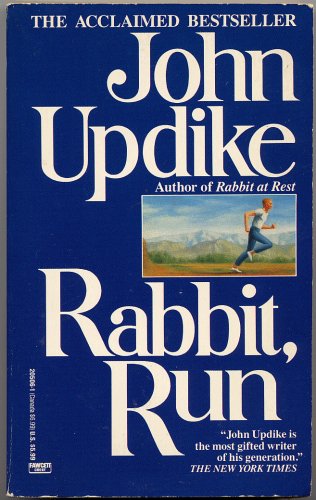
Book Review: 'Rabbit, Run' by John Updike


This review is for the first novel of the omnibus edition 'Rabbit Omnibus: Rabbit Run, Rabbit Redux and Rabbit is Rich'. (Also, I discovered an interesting typo in the Pascal epigraph in this edition. Mine has 'harness of heart' instead of 'hardness' which has a completely different spin to it.)
’Proverbs, proverbs, they’re so true,’ Jimmie sings, strumming his Mouseguitar, ‘proverbs tell us what to do; proverbs help us all to bee—better—Mouse-ke-teers.’
Harry ‘Rabbit’ Angstrom is not a good Mousketeer. Once he was, when he was adulated for his relatively strong high-school-level basketball skills. There was certainty in heroism. He was strong and tall and handsome and ... first rate. There was a role and rewards. It was easy to be in, and still be truthful. External circumstances were easy to live with.


But, it did not carry on into burgeoning adulthood. Rabbit become normal. He becomes second-rate. External circumstances are harder, and concessions must be made to stick with them.
’Right and wrong aren’t dropped from the sky. We. We make them. Against misery. Invariably, Harry, invariably ... misery follows their disobedience.’
He disobeys. And misery follows. But people make concessions for him, every concession; and you’ll hear many a reader rattle on about his selfishness and his narcissism, and these things are true, up to a point; but, paradoxically, he remains a hero through his demand that life be truthful, and the rejection, in the end, of the constant, needful lies of ‘rightness’ as his coach would have it. He has said that ‘we’ make them, not Rabbit, not himself, but the big awful crushing ‘we’.
"What else do you like about me?"
"... you haven’t given up. In you’re stupid way you’re still fighting."

And that’s what Rabbit runs from. Not successfully. Not well. Not to some great reward for his efforts; but his misery is his, and there is a happiness in that. What is the ‘right thing to do’ and what makes of us ‘a monster’ and how these things intersect is played with masterfully. When Rabbit does ‘the right thing’ at one point, the pivotal ‘bad thing’ could be said to happen as a result. Or not.
’Who cares? That’s the thing. Who cares what you feel?’
’I don’t know,’ he says again.
Updike has Ruth emphasise what not you. It’s not really even personal. It’s complete. He abandons due to his abandonment. He lets go of that which refuses to cling. He runs because he knows he has to get away to remain real, while knowing that there’s no escape. There’s nothing else there, nowhere to run to, but maybe the act of running is enough. Maybe that’s it. He certainly doesn’t know. It’s an illusion too, the spur to run. In the end, it’s an illusion that trips him. But he knows it is. And yet, something internal happens. Something that maybe can trip Pascal.
This illusion trips him. His hands lift of their own accord and he feels the wind on his ears even before, his heels hitting heavily on the pavement at first but with an effortless gathering out of the sweet panic growing lighter and quicker and quieter, he runs. Ah: he runs. Runs.


Something also needs to be said about Updike and his brilliance in this novel, which is heartbreakingly fantastic. Americans in particular seem to despise him, when any other country would honour him to bits. I’m convinced that haters of his work are literary-cripples, either born that way or gender-politically-handicapped; and I’m beginning to think there is only a cure for the former of the two. There’s a sickness involved in it that is much wider than his oeuvre. But, maybe, ‘...the rigidity of hatred makes a kind of shelter for him.’ Or they’re just after the easy and effortless one-star-review hack not too many people will complain about. When you read his actual work, all these things sort of melt into like so many wicked witches of whichever direction you’re looking He’s not James Joyce (so don’t blame him for his style) but he might be called an American-lite version. Or Joyce translated into American, from the Irish-in-English. His shifts through stream-of-consciousness are more vivid and less real at the same time, but maybe more real for it?
Wonderful, women, from such hungry to such amiable fat; he wants the heat his groin gave given back in gentle ebb, Best bedfriend, fucked woman. Bowl bellies.
Keep running. Running. Even if it’s just on the inside.

Thursday, July 11, 2013

Book Review: 'The Fall' by Albert Camus

The Fall
In any case, I only like confessions nowadays, and the authors of confessions write chiefly in order not to confess, saying nothing of what they know. When they pretend to be owning up, that’s the moment to beware: they’re putting make-up on the corpse.

As far as his prose-fiction output goes, Camus is most well-known for three works: The Stranger The Plague and this one, The Fall. The first two have definitive places amongst cycles of his work within his oeuvre and the development of his ideas: the Absurd and Revolt respectively. But the The Fall does not. It wasn’t even part of the planned third cycle—Love—that was never completed due to Camus’ accidental death. It was a short story that grew into a novella, and was published separately to the other short stories that were put together as Exile and the Kingdom.

Let me firstly say that, of the three theatrical versions of Camus’ work that I have witnessed, it is Drew Tingwell’s performance as Jean-Baptiste Clamence, in Michael Cronin’s adapted-for-the-stage version of this book, that has most occupied a Camus protagonist for me during my rereading of his work this year. I could visualize him delivering some of the key lines, like:

But let me introduce myself: Jean-Baptiste Clamence, at your service. Delighted to meet you. You must be in business? More or less? Excellent reply. Judicious too: we’re only more or less in anything.

Maybe because it is so suitable for a one-man-show? I mean, as a novel, it is a one man show… Anyway, he seems to occupy Clamence for me now in a way that the actors who played Meursault and Rieux do not.

This novella is a confession, and a confession about the nature of confessions and what they mean. How they work for us. Why they’re necessary. What makes someone guilty, what makes someone innocent, in a specific and a general sense. Clamence adopts the role of Judge-penitent, a role he does not explain completely until the very end of the story. We, the reader, the nameless companion in the bar and streets and houses of Amsterdam, occupy the role of hearing the confession of this fallen man. And he pokes us along at a pretty brisk rate, often teasing us with information that is still-to-come.


We follow his progression as a lawyer defending those who need to be, but always on ‘the right side’. He is beyond reproach, and he enjoys this position immensely… To be above, looking down. But an event occurs, mirroring, very gently, an event that occurred in Camus’ life, that causes a breakdown in the character of Clamence, a questioning of himself, a sense of guilt that was always there, that should always have been there, but he had resisted. And he feels the judgement of all around him. He regularly hears phantom laughter that comes from nowhere.

Later, talking about Jesus, he finds room to condemn Him as guilty, even before he’s born. No lamb, He…

And then he went away forever, leaving them to judge and condemn, with a pardon on their lips and a sentence in their hearts.

In some ways, as Robin Buss’s introduction touches on nicely, Camus is responding to the Paris intellectuals who froze him out over his inconsistent politics … inconsistent in the sense that Camus wasn’t ever happy to accept any manifesto as unquestionable blueprint for Life. This novella is his response, an appropriately literary response that assaults his ‘enemies’, while at the same time does not absolve himself.


Bistro atheists at work...

And while this is an interesting historical and biographical point, Camus reaches much further. You can easily cast contemporary roles for the ‘bistro atheists’ he talks about.
They’re free, so they have to get by as best they can; and since, most of all, they don’t want any freedom, or sentences, they pray to have their knuckles rapped, they invent dreadful rules and they rush to build pyres to replace churches


Camus is an atheist, but, he cannot so easily jettison the depth of moral consideration and conviction of Christian theology … not when he mistrusts the purposes and ‘paydays’ of what is offered in replacement, and Clamence expresses some of that, but always with apology.

In short, you see, the main idea is not to be free any longer, but to repent and obey a greater knave than you are.

If Meursault is the Outsider, then Clamence is the Insider. The Outsider ascends to death on innocence, the Insider falls to life in guilt.

Aren’t we all the same, continually talking, addressing no-one, constantly raising the same questions, even though we know the answers before we start?

Clamence is the man for our times. He is our Janus, the kind we worship. He would be a celebrity now, not a lawyer, but an actor playing a lawyer on a major HBO big-budget series, the kind people talk about at water coolers and on Facebook pages. And the charitable works he would perform! You would see all on his Twitterfeed. Our age would have sustained him far longer than the 50s could…

Some mornings, I would conduct my trial to the very end and reach the conclusion that what I excelled in above all was contempt. The very people I most often helped were those I most despised.

Sunday, June 30, 2013

Book Review: 'Women' by Charles Bukowski

Bukowski is a five star poet writing a three star story, averaging out to four stars: but with a +1 star for pure, unmixed vodkaric fucking artistic courage … if you’ll pardon the bland but necessary tautology. Instead of a Nobel Prize, a Purple Heart and a Medal of Honor should have been meted out to him. When Chinaski—Bukowski’s fictionalized self—is asked about the kinds of writers he likes, the attribute he mentions about them is their bravery. He’s asked: why?
“Why? It makes me feel good. It’s a matter of style in the face of no chance at all.”
And that’s what he is.

The declarations and codifications of his writing seem to baffle him. The misos or the isms. He’s aware of them. But he goes on. You can beat him up. You can run him down. You can trash his typewriter in the middle of the road. He not only takes his chances, he understands them. They are nil.
"What do you think of women?" she asked.
"I'm not a thinker..."
Chinaski seems to be aware of the vanishing-point that is the saturation of hate-ideology, and in the face of it, he places himself, not with any Saint George-like ideal of conquering it, but at least if he can just…be…him… that’s style in the face of no chance at all. That is courage. Once they have absorbed the entire avenue of discourse open to the writer, then ‘fuck them’ becomes all that you have to at least bridge between the body of it all and your own yawp.
Love … is like trying to carry a full garbage can on your back over a rushing river of piss.
Love was for guitar players, Catholics and chess freaks.
For Chinaski, the other side of bravery is love. Not in an antonymic sense, but it is the sense, the device, the object by which you fall into something that becomes too great to have courage through. This is why he often expresses awe in its face, because it is the one thing that can really defeat him. He expresses pity for those who he encounters who seem to be under it, he expresses self-pity for the one time in the past when he was also so afflicted. He avoids women who have men who love them.
Maybe I should have slammed her? How did a man know what to do? Generally, I decided, it was better to wait, if you had any feeling for the individual. If you hated her right off, it was better to fuck her right off; if you didn’t, it was better to wait, then fuck her and hate her later on.
description

Chinaski is an absurd hero. He is fully aware of the absurdity of his condition in the story, and regularly expresses complete bafflement for how he is making a living as a poet, and how these women are appearing in his life … and what they’re prepared to do for him. But he still takes what is given freely, and he gives freely. He undergoes ordeals that would have me in a homicidal fit of rage, and yet he can go berserk if the music is too loud; a woman can all but kill him in the street, but he will still help them move house; he is contradictory, obtuse, will-full, forgiving, passionate and reserved, destructive and self-destructive, creative and lacking-in-imagination. He is one of us, one of the losers; cast as a winner. He celebrates his winnings, but is humble enough to remain a loser.
"I never pump up my vulgarity. I wait for it to arrive on its own terms."
Which brings me to his three-star-ish-ness. I take notes while I read for future reference, along with a page number, and this kind of tells the story. Normally, the gems I unearth are pretty evenly spread out page number wise. With this book, there would be forty, fifty page gaps; and then a series of notes over one, two or three pages. It’s as though Bukowski has a series of great poetic works of character insight, and he strings them together to create a book.
"I write. But mostly I take photographs."
...he admits, jokingly, but it also rings true. He’s joined a series of fascinating shots together. It’s certainly well worth the read, as a tonic for our only-for-fun or moral-prescriptive emphasis on reading now fashionable.

What a rush to stumble upon a poet who is not a sociologist, who is not an organ-grinder, who is his own monkey.

This book won’t make you a better person, or a better citizen. It will make you more human ... more or less; it will equip you better for your own silence; it will sheath your soul more comfortably, because it will further develop that discomfort and anxiety that is the very definition of the human soul. And that is the object of literature.

"You write a lot about women."
"I know. I wonder sometimes what I’ll write about after that."
"Maybe it won’t stop."
"Everything stops."

Saturday, June 15, 2013

Book Review: 'The Plague' by Albert Camus

The Plague
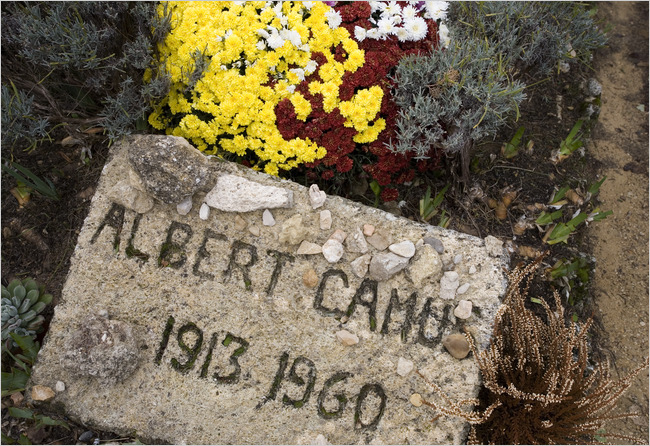
1913–2013 A hundred years of Albert Camus, a writer.

…and to state quite simply what we learn in a time of pestilence: that there are more things to admire in men than to despise.


Yes, Nazism influenced the writing of this story, Camus was living through it and resisting it, in his way; but it is not about it. This novel, published after The Myth of Sisyphus and written during the sometimes hostile response to the book, begins what became to be known as Camus’ ‘Cycle of Revolt’ (along with The Rebel and the plays L'état de siege and Les justes) It is of interest to note that one of the regular complaints regarding Camus’ series of essays (notice, I do not say ‘Book of Philosophy’, which he never did…) of The Myth of Sisyphus—by both Camus’ contemporaries and thinkers today—is that it is ‘too abstract’ to be taken as a serious philosophical tract. The journalist, Rambert, echoes them when he says to Doctor Rieux:
”You’re using the language of reason, not of the heart; you live in a world of … of abstractions.”
To which he later muses to himself:
Yes, an element of abstraction, of a divorce from reality, entered into such calamities. Still, when abstraction sets to killing you, you’ve got to get busy with it.
In this story, a city in North Africa, Oran, where Camus had lived for short amounts of time, becomes quarantined due to an outbreak of bubonic and, later, pneumonic, plague. Lots of people are dying and everybody has to deal with it, in their way. We follow the responses most closely of a Doctor (Rieux), a journalist (Rambert), a writer (Grand), an intellectual … for want of a better word (Tarrou), a priest (Paneloux) and a criminal (Cottard). Also of note is ‘the asthma patient’ that Rieux treats at key points in the narrative (in particular, right at the starts of the plague and right at the end. Why? Because his lung condition is mirroring Camus’ own (tuberculosis)—he required frequent treatments from Doctors, like Rieux—and it’s important to note that Camus’ often considered himself on the verge of death due to his condition, mirroring the psychology of those living with the plague: to live with the knowledge of the threat of imminent and unavoidable death.
‘They’re coming out, they’re coming out..’
He says gleefully. And later, at the end, he poses an important rhetorical question that’s been foreshadowed throughout the story:
”But what does that mean—‘plague’? Just life, no more than that.
And Tarrou, much later:
”…I had plague already, long before I came to this town.”
No, not Nazis, but life; but more specifically, life being brought into sharp focus, creating an awareness of it through an understanding that it ends. Being forced into exile by the plague, or not, the absurd conditions of life remain unaltered. It’s the awareness of the conditions that shifts through plague-caused exile: to be separated from the rest of the world, from love, from culture, etc; for it to be a part of your consciousness, and the consciousness of all the exiles around you, this is the plague. What does this do the people? It drives out Hope. It makes them live only in the past (through memories) and the present (through knowledge). The future no longer exists. Your illusions regarding your existence have flown. You have no peace.

description

This is the Plague. The awareness of the absurd.

The only option is revolt; even in the face of the unchangeable.

And through this it’s possible, maybe not to be a saint, but to be a man.

…it was only right that those whose desires are limited to man, and his humble yet formidable love, should enter, if only now and again, into their reward.
How these characters come to terms with the plague and, thus, the Plague, forms the bulk of the story; and how they all, in different ways, follow Rieux’s lead and accept revolt, forms its chief intellectual interest. Without wanting to give away serious plot points, think about this when one of them contracts both varieties of plague—bubonic and pneumonic—the person ever to do so…


Don’t get me wrong: this is also an aesthetic achievement of the highest order, even in translation: the scene with the dying boy reaches the aching terrible narrative beauty of one of Camus’ greatest literary heroes, Dostoevsky. But, indulge me in discussing some of these characters and how they played out in a kind of general sense, if you will…

Tarrou and Rieux have the most special relationship: the moment of ‘respite’ they share swimming alone at night in the forbidden sea is memorable to both of them, and to the reader. Just before hand, in conversation with Rieux, Tarrou comes to his main point about his life:
”It comes to this,” Tarrou said almost casually, “what interests me is learning how to become a saint.”
”But you don’t believe in God.”
”Exactly. Can one be a Saint without God?”
A little later on, Rieux finally responds:
”But, you know, I feel more fellowship with the defeated than the saints. Heroism and sanctity don’t really appeal to me, I imagine. What interests me is—being a man.”
”Yes, we’re both after the same thing, but I’m less ambitious.
Seeking sainthood is its own variety of retreat from the plague, not revolt. It’s full acknowledgement that the plague is greater-than. While Tarrou obsesses over existential issues, and broad morality, in his efforts to not transmit the plague to others, he can’t help but do so anyway.


Paneloux, the priest, and Rieux clash on the other side of the plague. When Paneloux is introduced into the story, it is early days in the plague: people are seeking the solace of the Church, and he delivers his First Sermon, which is your typical ‘this is God’s vengeance upon his misbehaving creation’ kind of fare. Rieux is unimpressed. However, he asks Paneloux to become involved in the Santization Groups and he accepts, throwing himself into the actions of the revolt against the plague. After the death of the boy scene, there is a shift in his beliefs, and his Second Sermon follows that event. For those who have read The Brothers Karamazov (if not, what are you doing reading this rubbish? Stop it and go out and read this book instead… Know wait, there’s time, as long as you don’t have plague: finish my review first…), this sermon could be read as how Aloysha should have responded to Ivan Karamazov when the death of innocents was put toward him as a reason to revolt against God (Book V, Ch. IV). Rieux summarises Ivan’s position nicely:
”And until my dying day I shall refuse to love a scheme of things in which children are put to torture.”
Instead of Aloysha’s quiet wishy-washy acceptance (coupled with his refusing to face the outcome of this acceptance) … a little like modern Western Christianity generally … Paneloux responds:
”Believe everything so as not to be forced to deny everything.”
”…they must acquire and practice the greatest of all virtues: that of the All or Nothing.”
He’s not saying that you’re either for God or against Him, but that you’re either with God or without Him. It’s no good being with Him when without plague, and without when you are. Because then you are without him anyway.

Rambert is the lover who wants to run from the plague. But comes to his own absurd realization.

Cottard finds the plague-stricken world better than the normal world.

Grand, the writer, revolts with the rest of them, but his life remains disturbingly unaffected. He obsesses over his opening sentence, which he’s been working on for years, mirroring Camus’ obsession with his book, which took him longer to write than any other. When Rieux gets a look at the full manuscript Grand is working on he notices that:
The bulk of the writing consisted of the same sentence written again and again with small variants.
In the end, even during the victory celebrations, the plague’s there, laying dormant, never really gone, waiting, even on ‘the bookshelves.’

Read this book. Get the plague.
Thursday, May 23, 2013

Book Review: 'Tropic of Cancer' by Henry Miller

Tropic of Cancer


The book is perhaps summed up best by one of its characters:

“…I’ll lay myself down on the operating table and I’ll expose my whole guts … every goddamned thing. Has anyone ever done that before?—What the hell are you smiling at? Does it sound naïf?”


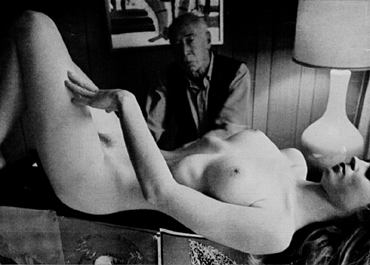
Henry Miller with Nude

It exposes. It hadn’t been done before (well, not in the same way). It is comic. It is naïf.

With Henry Miller’s bizarre and incongruous existence in his time and place, there’s a kind of sense of loss, that something was lost after him, that an opportunity slipped us by. He represents a fork in the road, and it’s a fork that was never really taken. Instead, he can be easily reduced to a series of issue based identity-political dot points. Easily, that is, by those that…

…live among the hard facts of life, reality, as it is called. It is the reality of a swamp and they are the frogs who have nothing better to do than to croak. The more they croak the more real life becomes.
The same sort of people that can look at this book, even the first thirty pages or so, even if that’s all they read and threw the mouldy paperback down in disgust and reproach, and then croak on about ‘narcissism’, about ‘dead white men’, about ‘misogyny’ about all the stinking murky depths of the swamp that they’re paddling in.

So, all the croaking aside, what is Miller’s project? He takes Walt Whitman by the end of his beard and drags him along behind him through the streets of 1930s Paris and all the humanity around him, the world of men and women, and goes the full length, he starts with drums and ends with dynamite, he makes the world more endurable in his own sight, he throttles all the birds in creation, he tries to look earnest and looks pathetic, he finds himself again naked as a savage, he makes pages explode, he disregards existent principles, he contradicts and paralyzes, he makes lists of experience, he lives a life rendered down to cunts and stomachs.

description

This is not fifty shades of fucking grey. This is not a series of banal-titillations made to feel extreme and naughty while you keep warmly rolling in the swamp, wrapped up in a bunch of ideas that’ll keep you moist enough to pass inspection. There is no comfort here, unless it is the comfort of understanding that there is no comfort. Perhaps you have to be hungry and desperate to get to that point? You have to be that to make ‘the guinea pigs squeal’. To know where to put ‘the live wire of sex’, to know…
…that beneath the hard carapace of indifference there is concealed the ugly gash, the wound that never heals.
Is Miller above all this crap? Looking down like a Titan? If he’s part Titan, he’s also part goat. He’s below it. He’s burrowing underneath like he’s a haemorrhaging mole. You’re not meant to love him. Or like him. Or respect him. He asks for nothing from you. He doesn’t ask for you to review his book, since the book is a failure, it's not even a book, because it has to be a failure or else it fails completely; and since reviewing it is just further croaking in the every-spreading swamp of reality. Looking up a picture to slot into the coding so that someone might Like it and say, hey, yeah, nice review man, I liked that book too, lots of fucking, gave me a boner; or no, I disagree, this only got printed coz it gave guys boners and this book was a waste of my precious time when I could be reading the latest Miles Franklin shortlist from onetofive or something exceedingly more contemporary andslashor relevant, or that currently has a film version out with [insert some cunt] in it. I mean there’s only one review that counts and, bango, you start writing the book out word-for-word in all its glorious lack-of-glory and all its primal failure that then bleeds into that time when you were living at the Villa Borghese, and maybe it wasn’t lice, and maybe it wasn’t cunt, or books or dreams you were asking from life, but there was shit happening that you might not want to put down on a piece of paper, since it would certainly be inappropriate and revealing even if you shook it really hard and laughed and covered it in irony since there’s actually nothing appropriate going on down there, under the carapace, where all you might need is to have a rosebush thrust under your nose.


It's all about a 'level playing field'. Apparently...

The reaction to the 2013 Miles Franklin shortlist would be fine if that was all there was to it: the best five books according the judges were these five books, let’s get on with it. But that’s not the case. It’s the ‘first ever all-women’.  Ignore the fact that the men who’ve been on it have been writing for—and read primarily by—women for years, so that the award itself has been irrelevant to more and more men every year, probably since David Foster. But an all-women shortlist isn't un-level, since there have been four all-men ones in the past, reductively referred to as ‘sausagefests’ (making this one a crackcarnivale?). So the playing field is not this one shortlist, it is the amount of shortlists that your sex-team gets to dominate. And, if we get to the point that there is a fifth all-women shortlist, then the playing field will shift again to accommodate that.

Unfortunately, it would seem, the Stella prize invention was premature: They didn't give the Miles Frank team time to adjust… 

This is not all about a ‘level playing field’ for both sexes. It’s about creating a heavily graded playing field, and then teaching men to lean as hard as they can to one side before they look at it.

Like it has in other areas of writing and publishing, women dominate fiction writing, publishing and reading, so those playing field angles are all dealt with and level (again, as you long as you lean far enough). So we move on to some area where we can accommodate that, and find something, anything we can use to further ‘level the playing field’. So it comes down to: statistics collected on how many women writers are reviewed in major periodicals compared to men; and—look out you dwindling few men who still actually read any fiction—how many women authors and/or women-authors’-stories-about-women men read compared to …well … I suppose, anything else. Once these are dealt with, and ‘leveled’, then there’s sure to be something else.

It’s quite obviously, once you strip back the rhetoric and look at what is actually being done, about Total War, in a very Machiavellian sense. The playing field is not level until Total Domination occurs, until there is not one single tenuous statistic that can be teased out that does not favour your sex-team. It’s the same in higher education. Once you dominate overall, start looking at individual faculties. Once you dominate all the faculties…

…you just keep going.

But the whole time you say that you’re all about equality of opportunity.

Like the Roman Empire. Legions are notoriously difficult to disband. And if you don’t disband them, because it’s so difficult and hard and quite a fight and you may look foolish and reactionary and unprogressive, then they go ahead and create the war for them to fight in.